Posts

Environmental Law Opportunity

The University of Arkansas School of Law has an official job notice for a tenure track position that has been circulated.  While the approved notice list a variety of needs, there is strong faculty support for using this position to build our environmental law offerings. Any environmental law attorney or professor that is interested should contact us immediately. The opportunity for collaboration with the LL.M. Program in Agricultural & Food Law as well as interdisciplinary sustainability initiatives throughout the University of Arkansas campus make this a unique opportunity. Interested candidates may submit a letter of application and resume, including three professional references, as email attachments to Terri Huckleberry, Assistant to the Dean, at terri@uark.edu, or through regular mail to the University of Arkansas School of Law, WATR 167, Fayetteville, AR 72701. Please help us spread the word to colleagues that you know.


The Frugal Traveler on "The Center Cut": A New Yorker Learns Something about Farming and the Midwest

I have enjoyed immensely following Seth Kugel, the NYT 's "Frugal Traveler," the past six weeks as he has made his way through what his summarizing installation calls (in the print edition) America's "Center Cut," from Baton Rouge, Louisiana, to western Minnesota.  (I note, by the way, that his journey covers the territory of the federal Eighth Circuit, but with the additions of Kugel's Fifth Circuit kick-off and his brief foray into Kansas).  In his grand wrap up in today's paper, titled (online) "What I Learned Driving Through the Heartland," Kugel's lede has a decidedly agricultural flavor that I cannot resist highlighting here for Ag Law readers: �The udder on this cow just keeps getting better and better as the day goes on,� remarked Barry Visser, Kandiyohi County Fair dairy cattle judge, over the PA system. A boy led his prizewinning Holstein away as a friendly crowd of western Minnesotans, and one out-of-place New Yorker, look...

ACA will raise cost of farm labor--and therefore food

The New York Times   reported today about the consequences of the Affordable Care Act (ACA) for the cost of farm labor and, in turn, the cost of food.  Sarah Varney's story is set in California, where farm laborers are typically employed year round rather than seasonally, as the case in many other places.  (Another post about year-round ag workers is here ).  This means farm labor contractors cannot easily put the "workers on a 28-hour workweek like Starbucks, Denny's and Walmart are considering" doing to avoid the ACA mandate.  It also means that the contractors, who operate on very small margins--around 2%--will have to raise the prices they charge farms, which will in turn push up food prices. Varney writes:   Insurance brokers and health providers familiar with California's $43.5 billion agricultural industry estimate that meeting the law's minimum health plan requirement will cost about $1 per hour employee worked in the field.    ...

Sugar Love: A Not So Sweet Tale

Image
The August issue of National Geographic Magazine has a fascinating article titled, Sugar Love: A Not So Sweet Tale .  It's a fascinating article. In the beginning, on the island of New Guinea, where sugarcane was domesticated some 10,000 years ago, people picked cane and ate it raw, chewing a stem until the taste hit their tongue like a starburst. A kind of elixir, a cure for every ailment, an answer for every mood, sugar featured prominently in ancient New Guinean myths. In one the first man makes love to a stalk of cane, yielding the human race. At religious ceremonies priests sipped sugar water from coconut shells, a beverage since replaced in sacred ceremonies with cans of Coke. Our love of sugar is traced back through the centuries, chronicling its rise from a "luxury spice" to a "staple, first for the middle class and then for the poor."  The need for sugar has fueled colonialism, slavery, and widespread environmental devastation.  Yet we always seem to wa...

Thoughts on Food Assistance and the Farm Bill Debate

Image
The House of Representative's decision to strip the Nutrition Title from the Farm Bill before passage and the targeting of the food assistance programs for drastic budget cuts prompt me to offer my perspectives.  Much of the discussion has been misleading. First, clarification of the problem. �Food security� means �access at all times to enough food for an active, healthy life for all household members.�  According to the well-document USDA Economic Research Service Report, Household Food Security in the United States in 2011 , almost 15% of Americans were food insecure at some time during 2011, with �5.7 percent with very low food security�meaning that the food intake of one or more household members was reduced and their eating patterns were disrupted at times during the year because the household lacked money and other resources for food.� In Arkansas, where I live and work, the rate is even higher, with a food insecurity rate of 18.6%. Even more alarming -  28.6% of A...

Planting the Seeds of a Real "Green Revolution"

Image
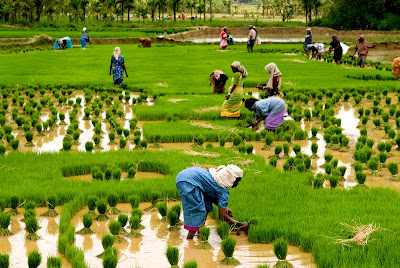
From Al Jazeera, comes this video on how roughly � two million farmers in the Indian state of Andhra Pradesh have ditched chemical pesticides in favour of natural repellants and fertilisers, as part of a growing eco-agriculture movement. � This represents, I think, agricultural production (pardon the pun) �on the ground ,� in a literal and figurative sense in contrast to hyper-industrialized capitalist agriculture, as an eminently rational process of political economy and ecology (thus, political ecology) beyond the impoverished assumptions of Malthusian Social Darwinism, the political premises of messianic neo-imperialism, and the Promethean promises of bio-technology (recall, for instance, the extent to which America �s export[1] of plant-breeding science was an integral part of the Cold War �s defense of capitalist political economics and economy and the �battle for freedom �). In other words, the original Green Revolution, as John H. Perkins argued in Geopolitics and the Green ...

Maine Law Review Food Law Symposium Articles Available

Announcement from the Maine Law Review (edited for this post): On February 23, 2013, the Maine Law Review organized a day-long conference in Portland, Maine devoted to discussing emerging issues in food law and policy.  This conference, Colloquium:  Local Food, Global Food:  Do We Have What It Takes to Reinvent the U.S. Food System? brought together more than a dozen legal scholars from around the country, including some from our Agricultural Law bloggers. The audience was comprised of members of the legal community, policymakers, farmers, and community organizers.  The conference became a forum for exploring the many ways in which people are challenging conventional thinking about U.S. food systems, and the hurdles they face in so doing. To continue to facilitate the exchange of ideas about these important and relevant issues, the Maine Law Review has devoted much of Volume 65:2 to legal scholarship on food law and policy. The spring volume, which includes sixtee...